

The Term "Performative Activism" Has Lost Meaning
On Sabrina Carpenter and the concept of "not giving the White House attention"

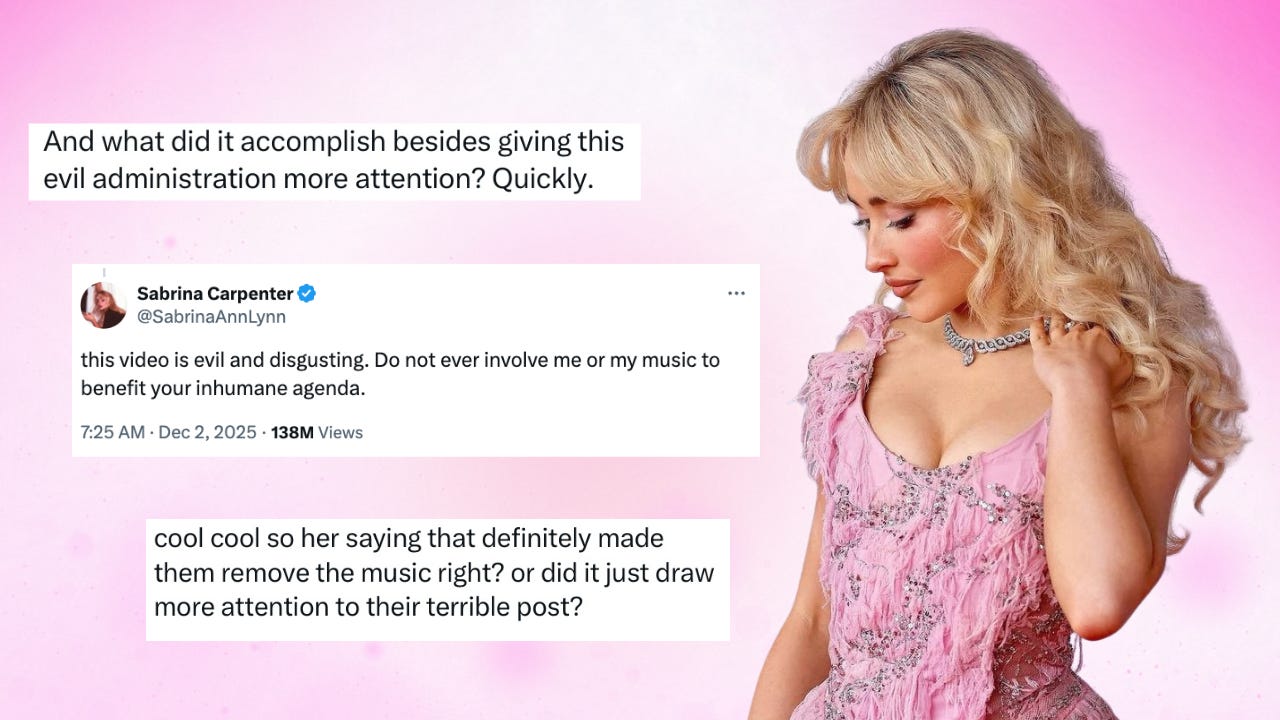
The past decade has brought about rising pressure for artists to make clear stances on social and political matters. More than ever, it’s not only what you say that is subject to interpretation, but also what you don’t say. The more musicians put their views on pressing issues on display, the more stark an individual artist’s silence can appear. At best, it‘s seen as indifference; at worst, it’s seen as contentment with current circumstances.
Simultaneously, many listeners are not so naive and can identify performative activism (advocacy that is more motivated by boosting one’s image than genuine compassion) in artists. The identification, analysis, and discussion of this phenomenon are beneficial for the most part, helping us evolve as better allies to communities we are not part of and causes that do not affect us directly.
If I were to assign a poster child of performative activism within the music world, it would be 88rising. In 2021, the record-label-media-company hybrid posted a yellow square on Instagram to protest anti-Asian hate crimes in light of the Atlanta shooting that killed eight people — six of whom were Asian women — that year.1

Many slammed the company for co-opting the infamous black square from the height of Black Lives Matter protests in 2020. On “Blackout Tuesday” (June 2, 2020), users flooded social media feeds with black squares to spread awareness of police brutality and express solidarity with the Black community; paradoxically, this prevented individuals from accessing resources under the #BlackLivesMatter hashtag. Others blasted the selection of the color yellow, which is often used to stereotypically describe Asian skin tones and is regarded as a slur against the Asian community. Since the post recycles a strategy that has been widely deemed unhelpful and counters the wishes of the community it represents, I say the performative activist critiques are accurate and warranted in this case.
However, what was initially used to describe grandiose gestures under the guise of self-interest is now loosely applied to any public effort from an artist that is not automatically world-altering: most recently, in relation to Sabrina Carpenter. Last week, the White House used her song “Juno” in a video montage depicting U.S. Immigration and Customs Enforcement (ICE) raids.2 She was quick to rebuke the unauthorized use of her music via Twitter.

As someone who opts for the written word over the spoken word whenever possible, this is one instance where I cannot string a poetically raw set of words while maintaining eloquence. Any earnest attempt from my part would read as painfully obvious, and it should. I hope it goes without saying how degrading it is to place a playful pop song about sex positions over brutal abductions and assaults. I hope it’s abundantly clear how these clips whitewash the destruction of communities and the trauma families, especially children, endure when they witness it firsthand.3
In short, calling out the White House’s “inhumane agenda” and demolishing the association with her music is the best approach Carpenter could take in this situation. This is not to say that her statement is the pinnacle of political protest, but refusing to comment would suggest the appropriation of her art is not repulsive enough to elicit moral clarification. Additionally, her words appear consistent with previous public actions of hers: earlier this year, she donated to the National Immigration Law Center and encouraged fans to do the same.

I’m not surprised she was met with contempt for her views. You can’t be famous without reconciling with the reality that everyone will form an opinion — constructive or not — on everything you say and do. What is particularly disturbing is when people who claim to oppose the Trump administration lead waves of backlash against her for speaking out. They fault her for, and I quote, “giving the White House more attention.”
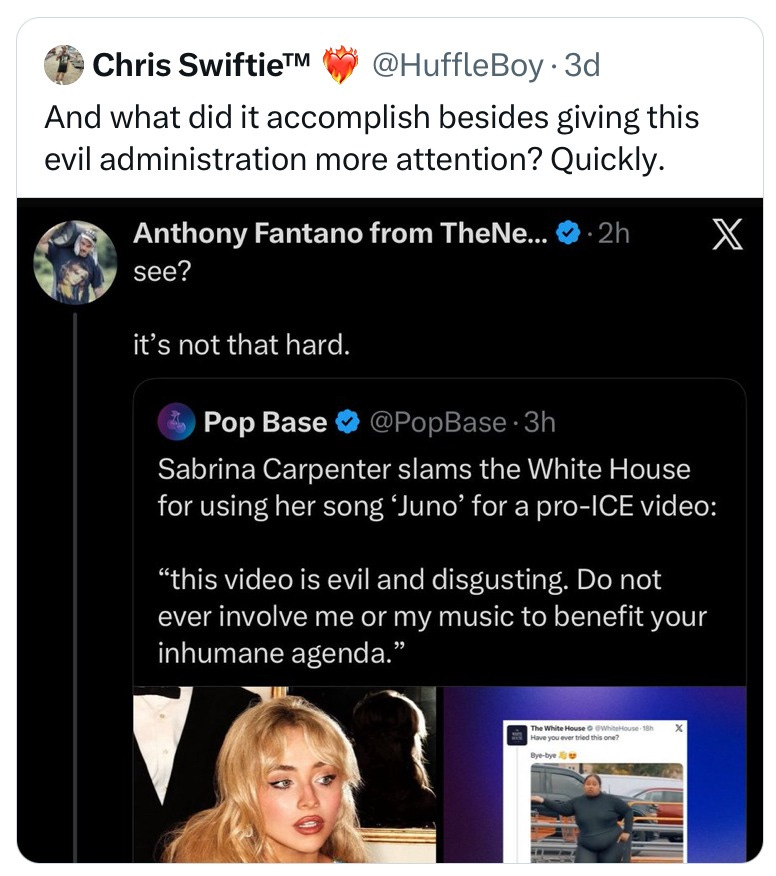
Don’t get me wrong, there are many scenarios where we should abstain from interacting with malicious actors. Whenever I receive a hate comment that is purely rooted in shock value and devoid of reference to my work, I hit the block button and move on with my life because the user has exclusively cultivated a crumb of relevance from their online persona. On the other hand, I don’t know who needs to hear this, but the U.S. government is not a niche internet microcelebrity. Any post from the White House will accumulate significant traction and engagement regardless. To reduce this matter to “falling for rage bait” is to infer that the impacts of this administration stop at our algorithms, and you cannot acquiesce your way into a better world.
I know it’s difficult not to feel powerless in this political climate. It’s instinctive to marinate in the mindset that you are just one person, to tell yourself that your words don’t carry any weight. But then this shapes our perspective of others who attempt to enact some form of positive change despite their limitations. The problem with this line of thinking leads to another common criticism of Carpenter’s response — that her words are essentially performative since they did not bring about a permanent result.
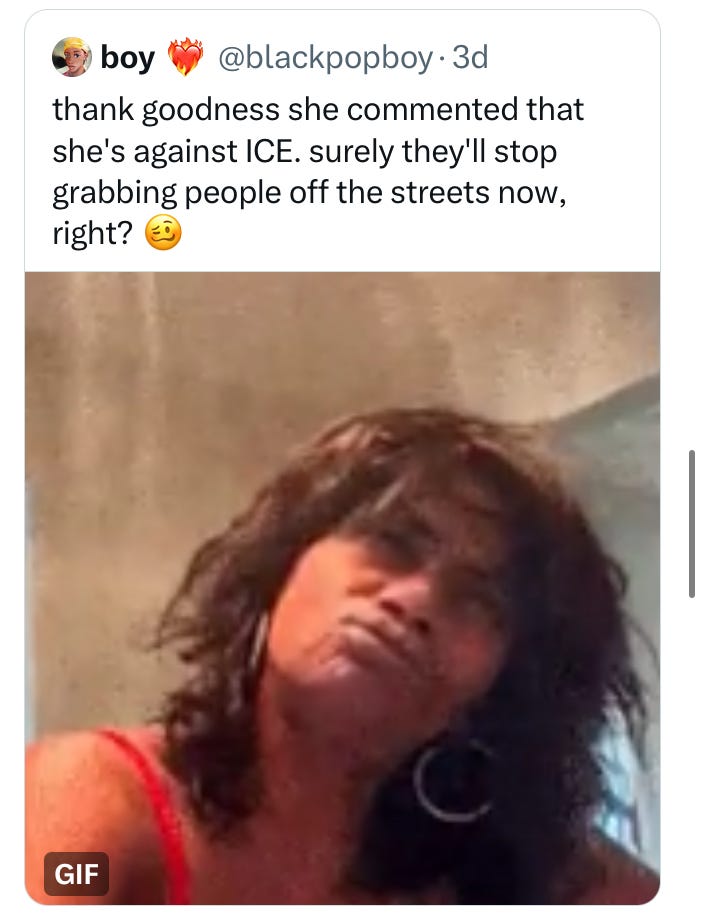
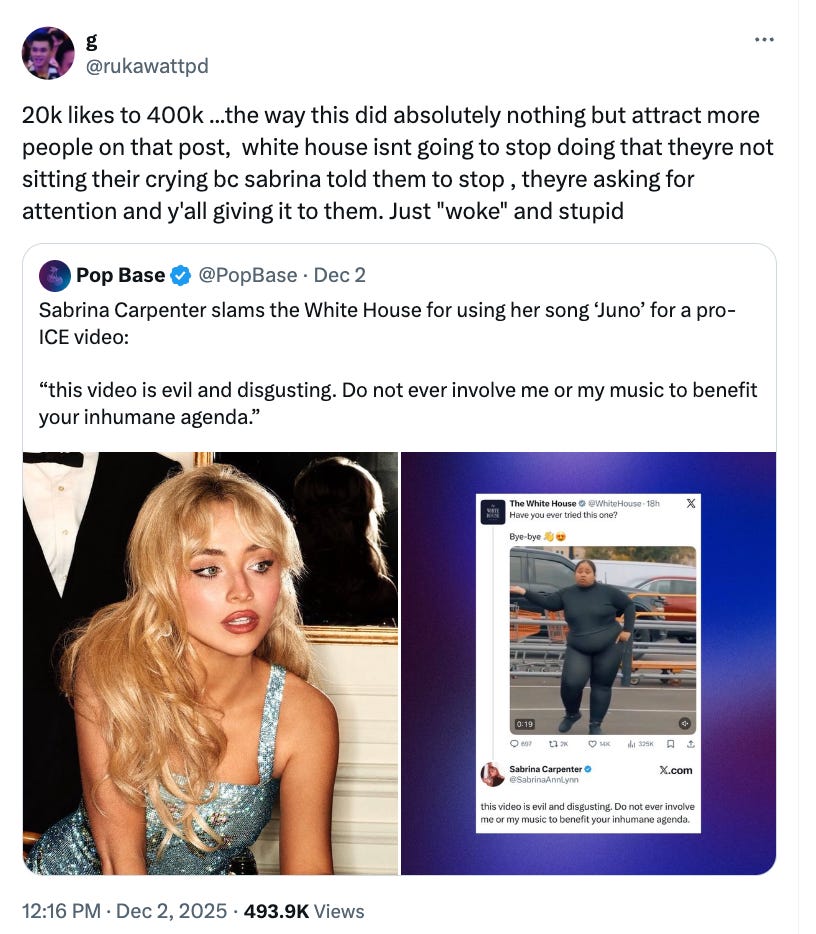
Questioning a celebrity’s activism, how it serves their reputation, and its greater impact should be a standard practice. As much as I commend Carpenter’s response, I do recognize how it can sustain an image of authenticity, further building trust in her adolescent and young adult audience. With that said, I take issue with dismissing her statement for her inability to singlehandedly combat the spread of anti-immigrant rhetoric and the escalation of ICE raids. They disparage because they look for solutions instead of efforts and heroes instead of coalition building. Two things can be true at once: we can hold reverence for individual integrity while acknowledging that a collective is necessary for meaningful, long-term progress.
If it was not already clear from the recurring flaming heart emojis4 in the above screenshots, these critiques have largely come from fans of Taylor Swift, another artist who has been on the receiving end of the White House’s antics. Last month, they used her song “The Fate of Ophelia” in a pro-Trump TikTok video. She has previously condemned the administration on several occasions,5 though she has yet to comment on this specific matter — that alone has inspired a multitude of thinkpieces and contributions to online discourse.
As one can expect with the extreme ends of a massive fanbase, several Swifties feel compelled to rationalize her behaviors (or lack thereof) in the face of critics, and undermining other artists who have taken clear stances against the White House seems to be a twisted means of defense. Some fans who strive to uplift Swift’s silence commonly refer to the White House’s self-disclosed motive of provoking outrage and gaining momentum through the implication of Swift’s music.

Even if we take this admission at face value, if we concede that they do want attention, how can we, in good faith, deduce that neglect is an infallible antidote for that end goal? Neutrality does not obstruct the end goal of notoriety: the administration’s use of her music remains widely available public knowledge and a burning hot topic in journalism6 and online discussion. Some may divert blame to reporters and critics rather than Swift, albeit silence has long been a visible facet of her star image.
I argue these alarming reactions from Swifties towards Carpenter are larger than Swift herself. There’s some reasonable frustration towards the disparities in how people critique pop stars vs. politicians,7 as many overestimate the influence of even the most powerful artists. Swift and Beyoncé, arguably the two biggest pop stars of the 21st century, have voiced support for Kamala Harris, and yet, that did not change the 2024 U.S. presidential election outcome. I presume there’s an amalgamation of annoyance towards some unrealistic accountabilities of celebrities and ever-growing defeatism (even in those with progressive viewpoints) coming into play.
In some respects, these tendencies may be more pertinent to fandom culture as a whole. I see concerns from fans for the myriad of consequences artists may face, and they have utilized the administration’s follow-ups to Carpenter as a vindication of Swift’s lack of a response. The first being a pun-ridden remark that screams “byproduct of the Gen Z intern’s ChatGPT session,” although the White House account on X did delete the original video after offering this lousy excuse of a clapback. Later, they tweeted another video containing footage of Carpenter’s 2025 appearance on Saturday Night Live.8 Still, I don’t think these retorts render Carpenter’s statement futile nor minimize her dignified countering of anti-immigrant propaganda made in her image, but I digress.
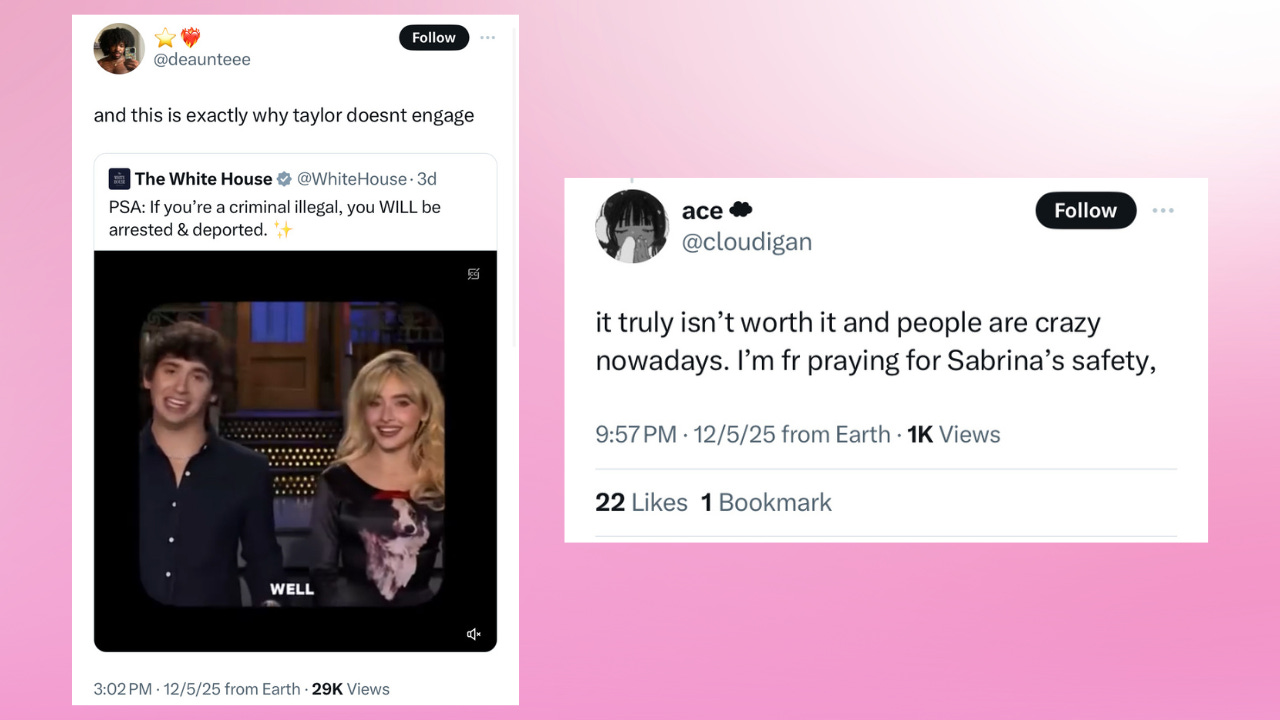
In terms of artists’ safety, the topic is a double-edged sword. Having millions of eyes on your every move, every second of the day, undeniably opens the door to privacy violations and threats of physical harm.9 At the same time, A-list celebrities can afford extensive security protections; the average person working a 9-to-5 job, living paycheck to paycheck, cannot. If it’s not safe for a mega superstar to be political, how do we determine who takes on the task at full force? I don’t want to discredit the dangers artists face — it’s just that this point of contention can implicitly favor the livelihoods of celebrities over everyday people who have far more to lose.
On the contrary, I’m less sympathetic to the notion that negative feedback is a valid deterrent for an artist’s political involvement. If Swift, for instance, were to denounce the administration’s use of her music, people would still nitpick her articulation, call her a white feminist, and interrogate the authenticity behind her beliefs. As true as this is, you also cannot please everyone; therefore, it cannot be a proper justification.
It’s ironic how those who paint Carpenter as performative are, in the same breath, using this as a rationale for someone else to remain silent. Only taking action when you are certain you will be shielded from criticism is performative activism in itself. In theory, I don’t view political advocacy as a celebrity’s contractual obligation. On a human level, I will respect someone a lot more for defending their morals. And anyone who consciously incorporates social or political causes into their brand must know that principle cannot peacefully coexist with the desire for universal approval.
88rising eventually deleted the post and issued an apology: “We are not trying to start a yellow square movement, though we understand how it was misinterpreted,” the company continued. “We are heartbroken and wanted to share our thoughts on the horrific violence in Georgia and to decry the racism against the Asian community.”
The White House’s unauthorized use of music on social media and for apolitical rallies and campaigns without prior permission is a tale as old as time. To name a few, artists like Olivia Rodrigo, Beyoncé, and Jack White have also called out and/or pursued legal action against the Trump administration for this.
Bassett Ratto, a child clinical psychologist in Washington, D.C., speaks directly to this trauma:
“What [children] see are their classmates, their family members, their neighbors often being apprehended in violent and confusing ways while doing things like picking up their children from the bus stop or going to their jobs, and this, for children, creates a sense that nowhere and no one is safe.”
These emojis are regularly used to represent Taylor Swift’s latest album, The Life of a Showgirl.
Swift has called out Trump in the Miss Americana (2020) documentary and on X for his remarks about Black Lives Matter protestors in 2020. As a disclaimer, I am primarily fascinated by how fans defend an instance of her silence; I do not mention her to conspiracize about her genuine political leanings.
On December 3, 2025, TIME magazine published an article, “Sabrina Carpenter Becomes Latest Artist to Push Back Against Trump Admin Co-Opting Music.” They mention how Taylor Swift “has not issued any statement after she had her songs from her latest album The Life of a Showgirl used in White House materials.”
I have previously written about this sensation in my article, “Negativity Does Not Imply Critical Thinking.” Here, I use Chappell Roan as an example to unpack how many listeners bestow higher responsibility on an artist than a politician (Kamala Harris).
Edit: This post was deleted from the White House account on X after I published this piece.
Bear in mind, I do think attributing any threat an artist faces as a response to their political views is an oversimplification.
this is such a well structured and informative piece. You’re right, people will always form an opinion whether you do the ‘right thing’ or not
Hearty applause! I’m done for by the last paragraph; thank you so much for this enlightening food for thought and making it easy for the average person to understand. I was in a haze about performative activism and criticism against it, but I learned so much from this article, thanks to your wonderful writing!