

Negativity Does Not Imply Critical Thinking
The case for critical media literacy in online pop culture discourse

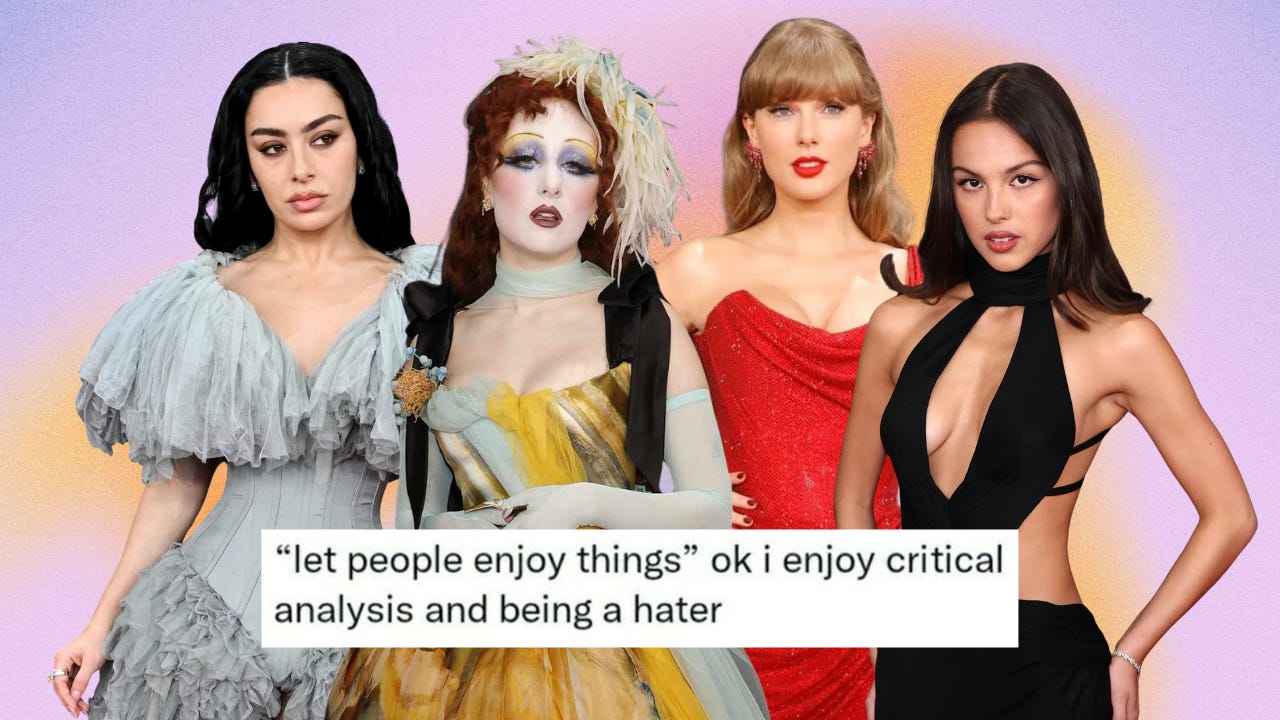
The Rise of Haterism
Negativity on the internet is far from a new phenomenon. I’ve long resisted writing about this facet of online discourse for the fear of inducing eye rolls and “no shit, Sherlock” adjacent reactions. In the year 2025, “Stan Twitter is bad” is a tired observation; there’s little nuance I can provide to this subject that hasn’t already been said. But what I have seen fewer people explore is the recent embrace of being a “hater” in virtual spaces.


Numerous memes and social media posts reclaim the “hater” label, providing an unprecedented, positive connotation to a standard insult. Not only that — the term is frequently used in conjunction with “critical analysis.”
I can understand the appeal and half-jokingly refer to myself as a hater on occasion! Too often, the “let people enjoy things” mentality inhibits constructive criticism, and superfans tend to interpret mere opposition against their favorite media as a personal attack.
For instance, this has been common among Taylor Swift fans amid the overwhelmingly negative, critical reception towards her newest release, The Life of a Showgirl. Many listeners do genuinely take issue with its production, lyricism, and concept. Rather than engage with these points directly, several Swifties insist that people who dislike the album are not “real fans,” have vendettas against Taylor’s happiness, and should simply listen to albums they like instead of sharing any negative opinions on the new record.


When we discourage disagreement, it’s no surprise that the modern re-invention of the hater has sparked widespread resonance. It’s a form of rebellion against the unconditional praise pervading fandom culture. If anyone with a remotely negative opinion is dismissed as a hater, why not subvert the term as a sign of wit? Maybe the critics aren’t content, but isn’t knowledge more powerful than blissful ignorance?
Even so, I don’t believe negativity should become synonymous with intellect in our collective consciousness. It’s not that every self-proclaimed hater isn’t actually thinking critically; my greater concern is a widespread association of the two, as contrarianism without a guiding framework is equally vapid as unreflected admiration.
Critical Media Literacy
To say that we are in a media literacy crisis is like saying “the sky is blue.”1 There’s no shortage of YouTube video essays and Reddit threads declaring the death of media literacy, and understandably so.
Neither U.S. adults nor K-12 students have received much exposure to media literacy within formal American schooling. Media Literacy Now’s national survey from 2022 reveals that only 38% of U.S. adults “reported learning how to analyze media messaging.” A study from the News Literacy Project finds that only 39% of American teenagers received media literacy instruction during the 2023-2024 school year. If there is an opportunity to equip media literacy in the K-12 curriculum, it is typically through the humanities, whose importance has long been disregarded.2
When stressing the need for media literacy, we generally refer to the ability to decipher media messages and distinguish facts from misinformation and disinformation. This is crucial, of course, but the practice does not stop there. Media literacy takes the traditional understanding of literacy — reading comprehension and writing skills — and expands it to all physical and digital texts. In other words, it entails competency in both analyzing and constructing deliberate media messages.
All of this is to say that the creation aspect is underrated; it is not exclusive to blatantly artistic endeavors such as writing a song, directing a film, or painting a portrait. Every time we post on social media, we are curating a message with a specific use of language and symbols, even if we do not always realize it. When engaging in online discourse, we are contributing to the spread of information, though the degree to which users are questioning media is quite iffy. I find that we can easily immerse ourselves in finer details and lose sight of the purpose behind critique.
Critical media literacy can further demystify the productivity of online discourse and inform how we contribute to public commentary. As defined by the Critical Media Project, critical media literacy is “an inquiry-based process for analyzing and creating media by interrogating the relationship between knowledge and power.” It builds on the foundation of media literacy, honing in on representations of people, ideologies, institutions, and social and environmental justice. There are six conceptual understandings and questions that help us put this theory into practice.

The first three understandings (“Social Constructivism,” “Languages/Semiotics,” and “Audience/Positionality”) speak to the translation of conventional literacy to other forms of media. They help us identify all possible creators of media texts, decode the use of language and symbols, and consider the different ways in which media can be interpreted.
The remaining concepts more directly address where knowledge and power intertwine. “Politics of Representation” illuminates how all forms of media are inherently biased and will either uphold or challenge power structures. “Production/Institutions” reminds us that there is often a commercial or governmental purpose motivating how media creators relay information. Notably, “Social & Environmental Justice” clarifies that media texts are never neutral and will always advantage or disadvantage ideas about people, communities, or issues.
Instead of seeking objectivity, critical media literacy reckons that bias is inevitable and neutrality is unattainable. There’s a common misconception that the highest quality information eliminates bias; however, bias is not inherently bad. For one, when it comes to defending human rights against oppression, democracy against fascism, and science against climate denialism, expressing bias in favor of these values is an act of integrity. Not all sides of an issue are valid. The middle ground — especially where morality is concerned — is not the most rational solution by default.
Whether it be positive or negative, bias is problematic when we do not address it and pre-existing beliefs supersede interpretation and analysis. Allowing first impressions to take charge stops us from interrogating language, context, and how dominant ideologies shape the media we consume. In this sense, the critical media literacy framework can help us recognize the weaknesses in online pop culture discourse beyond general misinterpretation of media messages.
Gaps in Online Pop Culture Discourse
It seems like every pop star — emerging or established — is deeply polarizing; Chappell Roan is clearly no exception. While she has pursued music for over a decade, she took the world by storm in 2024 after opening for Olivia Rodrigo’s GUTS tour and releasing her hit “Good Luck, Babe!” Upon breaking through the mainstream pop world, she was met with praise for her image of authenticity and unapologetic support for the LGBTQ+ community and Palestine.
But some deem her unfiltered expression of her social and political views as doing more harm than good. Much of the negativity towards Roan derives from her refusal to endorse former Vice President Kamala Harris during the 2024 U.S. presidential election. In an interview by Kate Solomon for The Guardian, Roan says:
“I have so many issues with our government in every way…There are so many things that I would want to change. So I don’t feel pressured to endorse someone. There’s problems on both sides. I encourage people to use your critical thinking skills, use your vote – vote small, vote for what’s going on in your city.”
On September 21, 2024, the Pop Flop account on X tweeted an excerpt from this quote; the post has amassed over 77 million views and 35K likes. It did not include Roan’s call for her audience to think critically and vote in local elections, nor did it provide a link to the original article.

Despite the omitted context, those who are more familiar with Roan’s support for Palestine interpret her unwillingness to endorse Harris as a response to the Biden administration’s involvement in the destruction of Gaza.3
The user below characterizes Roan’s stance as a “leftist” one, standing in opposition to Harris’s support of Israel. They write, “she won’t not vote,” distinguishing Roan’s decision not to endorse Harris from the act of voting itself.
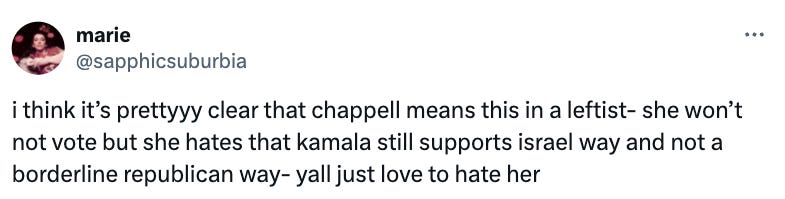
Without additional context, the Pop Flop tweet can make her seem ignorant of how the election outcome will and has impacted marginalized communities across the nation. The exclusion of Roan’s call for fans to vote in smaller elections especially exacerbates this; as a result, many users interpreted her words as a form of political apathy. Her critics primarily take issue with the phrasing of “both sides”; for them, this evokes a false equivalence between Democrats and Republicans.

Some users have gone as far as suggesting Roan’s decision not to endorse a candidate means that she is a Republican. I figure they suspect she is being dishonest to preserve her career, but this criticism does not even dissect the language that was featured in the Pop Flop tweet. It is also not a theory anyone can reasonably support with public knowledge, let alone prove.

If one positive has come from the Chappell Roan discourse, it's that it showcases the concept of “Audience/Positionality” in action. Here, we witness how contextual factors — such as someone’s knowledge of Roan’s public persona and the platform they access information about her — can allow for multiple interpretations.
An author is not the gatekeeper of meaning. If critical media literacy includes both analysis and creation, then this principle further applies to how a pop artist and their team curate their image. Reconciling with how information can be processed in different ways helps us craft media messages more meticulously and prevent misinterpretations that could be seen as antithetical to democratic and social justice values.
To be clear, Roan is justified in calling out the Biden administration’s complicity in the Israeli military occupation of Palestine. Our skepticism towards celebrities should extend to politicians, even if the politician in question appears to be the best possible candidate. Still, if she had initially clarified4 whether Democrats and Republicans are equivocally bad and specified the issues on “both sides” in the interview,5 perhaps fewer people would have misconstrued her statements.
Otherwise, her critics may have some grasp of “Social Constructivism.” I take it they consider her position as a celebrity with influence, hence why Roan elicited the reactions they did. I will say, the role of pop culture news accounts is not addressed in the creation of media messages. The same goes for “Languages/Semiotics,” as they are cognizant of how the phrasing of “both sides” evokes similarities to political centrists, though there is more they could deconstruct from the tweet (other word choices, selection of images, etc.). It also seems like the criticism is coming from a concern for social justice, though the degree to which Roan’s words advantage or disadvantage certain ideas or groups is not thoroughly investigated.
With that said, most of the negative discourse contains little to no comprehension of two essential concepts in critical media literacy: “Politics of Representation” and “Production/Institutions.” Many who criticize her language do not address the values and perspectives that are missing: her support of Palestine and advocacy for voting in local elections. Additionally, there is zero discussion of the incentives pop culture news accounts have in relaying these statements on social media. I assume there are engagement-driven motives, as eliminating bits of context that obscure the source material can provoke strong reactions — from rage to defensiveness — which motivate more people to interact with the post.
Overall, the negative reactions towards Roan’s statements indicate how users may employ some aspects of critical media literacy in online pop culture discourse, though there is a general disregard for source material and a limited understanding of how knowledge and power intersect.
As a breakthrough pop girl, Roan holds an interesting position: she cannot fully be seen as an individual in the same way the average person living paycheck to paycheck is, but can we bestow the same amount of responsibility on her that we would on an institution in this situation?
There’s an incoherent understanding of power where we demand accountability of the pop star but not the politician. I don’t think the two are mutually exclusive.6 When it comes to celebrities, the negatives of “cancel culture” are often blown out of proportion and hardly eradicate careers, but I find there are arbitrary conditions and disparities for critiquing power on the internet.
Negativity in Defense of the Status Quo
In some cases, users offer negative commentary that does not challenge and even benefits the status quo. When discussing pop culture controversies, several users will redirect blame towards individuals, deflecting it from larger powers. This mentality is abundant in album variant discourse: a hot topic in virtual spaces for music listeners.
Amid the vinyl resurgence, record labels have been releasing multiple variants of the same album — often with different color discs and/or album covers. This is common practice for vinyl, though this variety seeps into other music mediums: CDs, cassette tapes, and even digital downloads. Some artists also release bonus tracks that cannot be accessed on other editions of the same record; this tactic is increasingly controversial because it incentivizes consumers to purchase more versions to access more content.


From Olivia Rodrigo and Sabrina Carpenter to Billie Eilish7 and Ariana Grande, it’s clear the multiple variant model has become an industry standard. Yet, Taylor Swift is presumably the most criticized for it. When we consider her decades-spanning fixture in the zeitgeist and rapid album cycles, this scrutiny is not entirely unfounded; she is a convenient example for many to pinpoint. What may further distinguish her from her peers is that Swift and her team regularly impose time constraints on purchasing select digital and physical versions of her albums.

Regardless, the underpinnings of this trend cannot be neglected. Although online streaming is not necessarily more sustainable than physical music, we can integrate the critical media literacy framework to untangle the purpose and impacts of music marketing. With this in mind, I argue that the multi-variant method with added incentives to purchase multiple albums encourages overconsumption, leading to waste and pollution under the guise of consumer choice. As for the limited edition strategy, which seems to be more specific to Swift’s team, it preys on consumer panic to procure profits.
But instead of focusing on how these album rollouts contradict environmental justice and perpetuate capitalistic greed, much of the conversation centers on passing blame between artists. In response to the criticism Swift received for her physical and digital variants of THE TORTURED POETS DEPARTMENT, some fans have called out Charli xcx for her BRAT vinyl variants.

The rhetorical question of “HOW did [Charli xcx get] away with this” suggests that Charli xcx deserves more ridicule, with the image emphasizing BRAT’s physical variants surpass those of THE TORTURED POETS DEPARTMENT.8 With the use of “crucified,” they insinuate that the backlash facing Swift’s album release is disproportionate and unwarranted.
The underlying premise of the post is that if Charli xcx is releasing more physical variants than Swift, then it must be okay for Swift to do so. By shifting hostility from one artist to another, this post fails to dissect why variants are a problem in the first place. The priority is to extinguish the flames surrounding Swift, and the ethical question of multiple variants remains unanswered.
Meanwhile, others pass the blame onto music listeners for their susceptibility to consumerism: a form of negativity that operates in favor of how the music industry facilitates overconsumption.

To concede that “the entire industry is doing the same thing” is to conflate social norms with morality. Other artists releasing variants en masse does not absolve Swift nor her team of culpability. Just because a practice has become standard does not make it harmless.
Rather than interrogate the variant model, they describe it as a positive, providing listeners with the option to purchase their favorite version among a sea of choices. And it does! A sunset splatter vinyl or picture disc is far more alluring than standard black. Alternate covers pose solid substitutes for fans who dislike an album’s original artwork. Bonus tracks and photocard inclusions make us feel more connected to the music.
But let’s be real, is this marketing genuinely coming from the best interests of music listeners and nothing more? The music industry is exactly that — an industry. Labels will exhaust any means to get you to open your wallet to support them.
Now, I know what some of you may be thinking: people need to be smart about their money, and we can’t blame everything on record companies. This sentiment lies in the same tweet, which calls out individuals for “[feeling] the need to buy [all variants of an album]” while not being able to afford them, and argues that it is unfair for people to condemn Swift for enabling overconsumption if they are simultaneously influenced by consumerism.
Maybe individuals can improve their spending habits. I agree that dropping hundreds of dollars on the same album is financially unwise, and that couldn’t be me in this economy! Nonetheless, the environmental and exploitative implications of mass releasing — especially when tracklists and content are inconsistent across editions — cannot be attributed to affordability.
Purchasing more than one copy of the same record was not always normal. Even if someone can afford multiple versions of one album, why is there a widespread demand for fans to do so? Surely, this cannot be an organic occurrence. Should we not question how the demand for mass variants was manufactured?
To insist that overconsumption rests with individual choice is severely underestimating the matter. Someone’s decision to buy only one version of an album (or none at all) is responsible, but it cannot singlehandedly combat overconsumption. The scope of action required to make tangible progress on reversing the climate crisis requires structural change from governments, and industries should bear the responsibility to utilize more sustainable practices and materials in music marketing and manufacturing.
Despite the personal joys of collecting, we can acknowledge that a fan’s desire to do so does not exist in a vacuum. I get it — no one is “forcing” anyone to buy every version, but the messages in advertising do not manifest as explicit threats against consumers. Artists and labels are not pointing a gun at the heads of music listeners, but they are providing needless profit-driven incentives for them to feel like they are “better” fans. Thus, bluntness cannot be a requisite to justify critique, and the collective need for critical media literacy in this discussion is ever pressing.
The Future of Online Discourse and Critical Media Literacy
While there is value in negative discourse, negativity should not automatically be associated with critical thinking. In some cases, it works in favor of the status quo — targeting individuals instead of corporations and institutions. Other times, it may derive from first impressions and fail to thoroughly interrogate power.
Admittedly, the virtual world is not a perfect mirror of real life. It goes without saying that it’s easy to post our opinions online without first searching for additional context or crafting our words carefully. I’m aware I run the risk of naivety for expecting better from the internet. At the same time, I think it’s also uncritical to conclude “people on the internet need to get smarter” without elaboration. In blaming widespread media illiteracy on a collective lack of intelligence, we undermine our susceptibility and create an illusory armor of innocence that impedes further questioning.
In the same way we cannot deflect blame for overconsumption and environmental waste from corporations and industries onto individuals, we cannot infer that individual stupidity is the defining cause of media illiteracy. We should not view social media as an irredeemable cesspool either. There is proven potential for virtual discourse that truly challenges dominant ideologies; for the most part, I think the video essay realm of YouTube is a good example of this.
To see truly meaningful improvements in how society processes and engages with media, it is going to take the incorporation of critical media literacy in the K-12 curriculum and higher education. Starting at the elementary level, continuously teaching this framework alongside age-appropriate media makes these skills easier to obtain, familiarizing the concept and practice well before students reach adulthood.
It particularly helps to not only incorporate the critical media literacy frame towards media we detest but also towards media we hold in high regard. Moreover, reflecting on how certain films, music, or books incorporate specific symbols or language to effectively counter dominant ideologies can help reshape the expectation of negativity regarding critical thinking.
Inspired by my good friend Elie, who uses this phrase for comedic effect on a regular basis.
Note that the practice of media literacy is not exclusive to the humanities. For example, media literacy can be applied to STEM when analyzing scientific news and media portrayals of the climate crisis.
From October 7, 2023, to October 7, 2024, the U.S. had spent approximately $17.9 billion on military aid to Israel.
Shortly after the publication of her interview with The Guardian, Roan posted a video clarifying that she would vote for Harris but not endorse her.
Kate Solomon mentions that Chappell Roan has spoken about Palestine and LGBTQ+ rights in the article, though this is in a separate paragraph. When Roan states that there are issues on “both sides,” she does not explicitly mention Palestine here.
The interrogation of power should apply to both celebrities and politicians. I think we can critique how celebrities share their political views while being realistic about their influence and taking their respective fame and wealth into account.
Billie Eilish has released multiple variants of HIT ME HARD AND SOFT, but unlike the other artists mentioned, her records are made from recycled materials.
Charli xcx has released more vinyl variants for BRAT than Swift has for THE TORTURED POETS DEPARTMENT, but this tweet conveniently ignores how most of the criticism towards Swift also applies to her multitude of digital variants, not just the physical ones.
yes!! the “smart” asshole trope is so tired. such a good piece
I absolutely loved this and wish I could package it up and send it to multiple people I know for Christmas lol - Great Job!!